

Secondary Macronutrients Market Outlook 2035: Growing at 5.15% CAGR Amid Rising Precision Farming Adoption
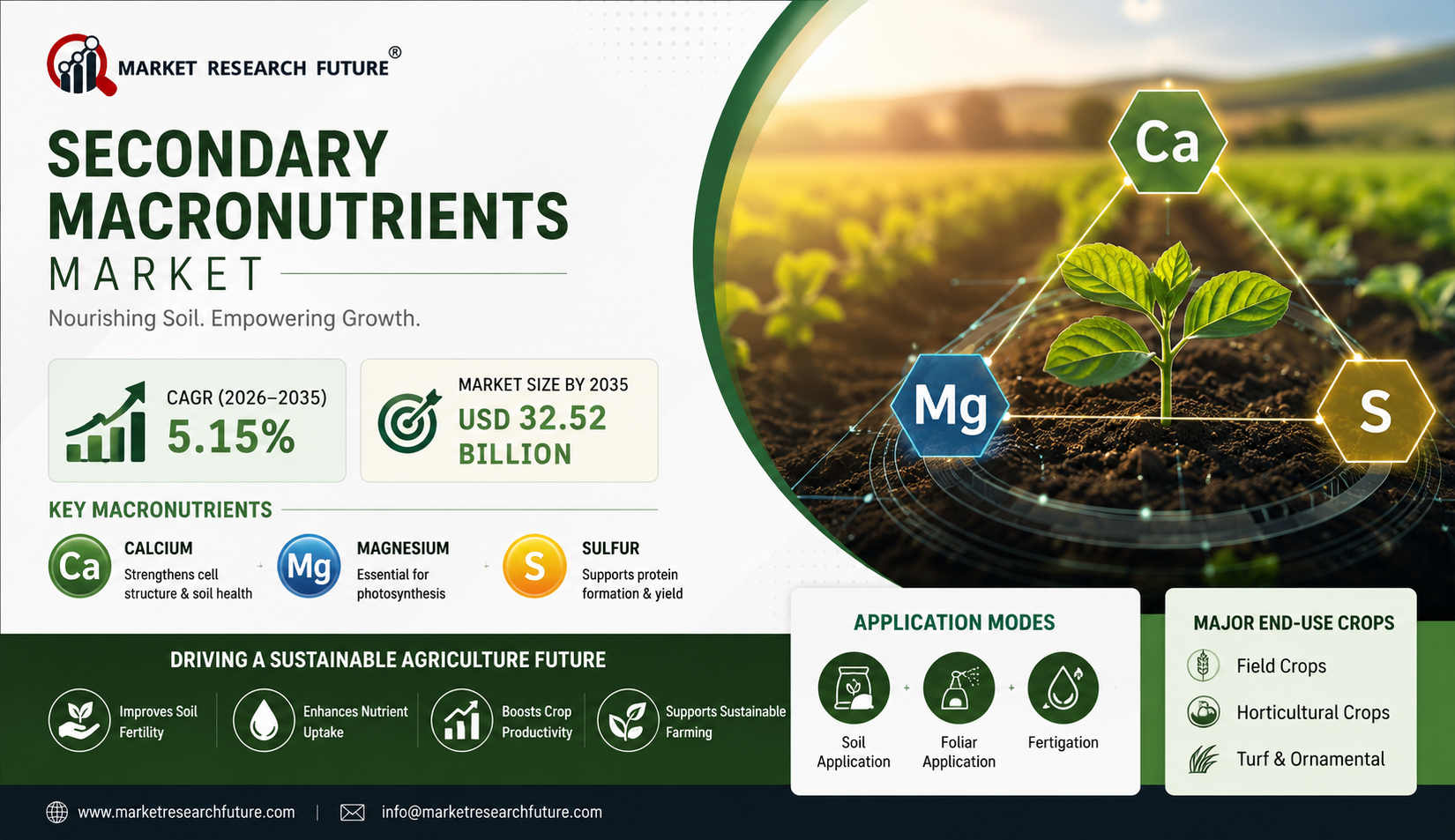
Global Secondary Macronutrients Market
The secondary macronutrients market was valued at USD 19.68 billion in 2025 and is projected to reach USD 32.52 billion by 2035, expanding at a CAGR of 5.15%.
NEW YORK, NY, UNITED STATES, July 13, 2026 /EINPresswire.com/ -- The global Secondary Macronutrients Market is entering a period of sustained and structurally important growth as agriculture systems around the world shift toward higher efficiency, better soil management, and more sustainable production practices. This growth reflects a broader transformation in farming, where nutrient management is no longer focused only on maximizing yield in the short term, but also on preserving soil productivity, improving crop quality, and reducing nutrient losses.Secondary macronutrients include calcium, magnesium, and sulfur. Although these nutrients are called “secondary,” their importance in plant growth is anything but secondary. Calcium strengthens cell walls and supports root and shoot development. Magnesium is the central atom in chlorophyll and is essential for photosynthesis. Sulfur is required for protein formation, enzyme activity, and oil synthesis. When these nutrients are deficient, crops may show reduced vigor, poor quality, lower resistance to stress, and weaker yields even if primary nutrients such as nitrogen, phosphorus, and potassium are supplied adequately.
The market’s expansion is being supported by rising awareness among farmers, agronomists, and policymakers about the need for balanced fertilization. In many regions, decades of intensive cultivation have led to nutrient depletion and soil imbalance. As a result, farmers are increasingly adopting fertilizers and soil amendments that restore calcium, magnesium, and sulfur levels. At the same time, modern agricultural technologies such as fertigation, controlled-release fertilizers, and digital nutrient management platforms are making it easier to apply these nutrients more precisely and efficiently.
Request for Sample of Report: https://www.marketresearchfuture.com/sample_request/8079
Latest Market Trends:
The Secondary Macronutrients Market is being reshaped by several important trends that reflect the modernization of agriculture and the increasing need for precision in nutrient application. One of the most significant trends is the adoption of precision agriculture. Farmers are now using soil testing, satellite imagery, GPS-guided equipment, and crop monitoring tools to determine exactly where and when nutrients are needed. This allows calcium, magnesium, and sulfur to be applied in the right quantity and at the right time, reducing waste and improving crop response. Variable-rate application technologies are especially valuable in large farms where soil conditions can vary significantly across a single field.
Another major trend is the rapid growth of fertigation, particularly in greenhouse farming, horticulture, and irrigated agriculture. Fertigation involves delivering nutrients through irrigation water, which improves nutrient uptake and allows for highly controlled feeding schedules. This method is especially effective for secondary macronutrients in water-soluble forms such as calcium nitrate and magnesium sulfate. Because fertigation reduces nutrient losses and supports frequent, small-dose applications, it is becoming increasingly popular in high-value crops such as fruits, vegetables, and ornamentals.
The market is also seeing strong interest in co-granulated fertilizers. These products combine secondary macronutrients with primary nutrients or micronutrients in a single granule, making application easier and more efficient. Co-granulation improves nutrient distribution in the soil and reduces the number of separate fertilizer applications required. This is particularly attractive for farmers seeking to lower labor costs while maintaining balanced nutrition.
Sustainability is another defining trend. Fertilizer producers are developing environmentally responsible formulations that support soil health and align with regulatory expectations. Organic-certified products, bio-stimulant-enhanced fertilizers, and low-loss nutrient formulations are gaining traction. These products are designed not only to feed crops but also to improve soil biology, enhance nutrient retention, and support long-term productivity.
Digital agriculture platforms are also becoming increasingly important. These platforms combine soil data, crop requirements, weather forecasts, and nutrient recommendations into a single decision-support system. By using digital tools, farmers can better understand nutrient deficiencies and optimize application timing. This trend is helping secondary macronutrient products move from being commodity inputs to part of a more sophisticated crop nutrition strategy.
Key Market Drivers:
The growth of the Secondary Macronutrients Market is supported by several strong and interconnected drivers.
1. Declining Soil Fertility (+1.2% CAGR Impact, Global, Long-term):
One of the most important drivers is the gradual decline in soil fertility caused by intensive farming, repeated cropping, and insufficient replenishment of nutrients. In many agricultural regions, soils have become depleted of calcium, magnesium, and sulfur due to continuous extraction by crops. This has created a strong need for fertilizers that restore nutrient balance and improve soil structure. As farmers become more aware of hidden deficiencies, demand for secondary macronutrients is rising steadily.
2. Mandatory Sulfur Recovery Programs (+0.9%, North America & Europe, Short-term):
Environmental regulations in industrialized regions have led to sulfur recovery from refineries and other industrial processes. This recovered sulfur is increasingly being redirected into agricultural applications. As a result, the availability of sulfur-based fertilizers has improved, and farmers now have access to more affordable sulfur inputs. This has been especially beneficial in regions where sulfur deficiency is common.
3. Expansion of Greenhouses (+0.8%, Asia-Pacific, Medium-term):
The growth of greenhouse farming is creating strong demand for precise nutrient management. Protected cultivation systems require fertilizers that can be delivered accurately and consistently. Secondary macronutrients are particularly important in these systems because crops are grown intensively and nutrient deficiencies can quickly affect quality and yield. The expansion of greenhouse infrastructure in Asia-Pacific is therefore a major growth engine for the market.
4.Precision Agriculture Adoption (+0.7%, North America & Europe, Medium-term):
The increasing use of precision farming tools is improving fertilizer efficiency and encouraging the use of specialized nutrient products. Farmers in developed markets are investing in technologies that help them monitor soil conditions and crop needs more accurately. This is driving demand for secondary macronutrients that can be applied in targeted and efficient ways.
5. Government Subsidies (+0.6%, Asia-Pacific & South America, Short-term):
Many governments are supporting balanced fertilization through subsidies, soil health programs, and nutrient-based incentive schemes. These policies are helping farmers afford better-quality fertilizers and encouraging them to move beyond reliance on primary nutrients alone. In emerging markets, such support is especially important because it lowers the cost barrier to adoption.
6. Co-Granulation Technology (+0.5%, Global, Medium-term):
Co-granulation improves fertilizer handling, application efficiency, and nutrient uniformity. By combining multiple nutrients into one product, it reduces operational complexity and helps farmers save time and labor. This technology is becoming increasingly attractive in both large-scale and specialty farming systems.
7. Rising Oilseed Cultivation (+0.4%, Americas, Long-term):
Oilseed crops such as soybean, canola, and sunflower require significant sulfur inputs for protein and oil formation. As oilseed cultivation expands, especially in the Americas, demand for sulfur-based fertilizers is increasing. This trend is expected to continue as global demand for edible oils and protein-rich crops rises.
Emerging Opportunities:
The market also presents several promising opportunities that could accelerate growth over the next decade.
1. Controlled-Release Fertilizers:
Controlled-release formulations, especially polymer-coated calcium and sulfur products, are gaining attention because they reduce nutrient losses and improve nutrient availability over time. These products can reduce losses by up to 35%, making them highly attractive for farmers seeking better efficiency and higher returns. Premium controlled-release products are expected to gain a larger market share by 2032 as adoption expands in both developed and emerging markets.
2. Digital Nutrient Management Platforms:
The integration of agronomic analytics with fertilizer recommendations is creating new business models. Companies can now offer subscription-based advisory services that help farmers determine the right nutrient strategy for each crop and field. This creates value beyond the fertilizer product itself and strengthens customer relationships.
3. Sub-Saharan Africa Soil Rehabilitation:
Large-scale soil restoration programs in Sub-Saharan Africa are opening new demand opportunities, especially for calcium-based soil amendments. Many soils in the region suffer from acidity, low fertility, and poor structure. Calcium products can help improve soil conditions and support more productive farming systems.
4. Organic and Bio-Stimulant Products:
As consumer demand for organic food grows, farmers are looking for nutrient solutions that are compatible with organic production standards. Secondary macronutrients formulated with bio-stimulants or natural mineral sources are well positioned to benefit from this trend.
5. Fertigation Infrastructure in Arid Regions:
Water scarcity is pushing farmers in arid and semi-arid regions to invest in efficient irrigation systems. Fertigation infrastructure allows liquid secondary macronutrients to be delivered with minimal water use, making it a highly relevant solution for climate-stressed agricultural zones.
Segment Analysis
The Secondary Macronutrients Market is segmented by type, application mode, and crop type, each of which plays a distinct role in market development.
1. By Type
Calcium - Calcium is widely used to improve soil structure, reduce acidity, and strengthen plant cell walls. It is especially important in horticulture, where fruit quality, shelf life, and resistance to physiological disorders depend heavily on calcium availability. Calcium-based fertilizers are also used to correct soil problems in acidic or degraded lands.
Magnesium - Magnesium is essential for chlorophyll formation and photosynthesis. Crops with magnesium deficiency often show yellowing leaves and reduced productivity. Magnesium fertilizers are increasingly used in specialty crops, orchards, and high-yield systems where photosynthetic efficiency is critical.
Sulfur - Sulfur is vital for amino acid formation, protein synthesis, and oil development. Demand for sulfur is rising because many soils are naturally deficient and because oilseed crops require higher sulfur levels. Sulfur fertilizers are also important in improving crop quality and nutrient balance.
2. By Application Mode
Soil Application - Soil application remains the most common method because it is suitable for large-scale farming and bulk fertilizer products such as gypsum and ammonium sulfate. It is widely used for correcting soil deficiencies and improving long-term fertility.
Fertigation - Fertigation is the fastest-growing application mode. It is especially popular in greenhouse farming, orchards, and irrigated horticulture. Because nutrients are delivered through irrigation water, fertigation improves efficiency and reduces losses.
Foliar Application - Foliar feeding is used when crops need rapid nutrient correction. It is particularly useful for high-value crops where immediate uptake is needed to prevent yield or quality losses. Foliar sprays are often used as a supplement to soil or fertigation programs.
3. By Crop Type
Field Crops - Field crops such as cereals, pulses, and oilseeds account for a large share of demand because they are grown on extensive acreage. These crops require balanced nutrition to maintain yield and quality at scale.
Horticultural Crops - Fruits, vegetables, and other horticultural crops are highly responsive to nutrient management. Because quality standards are strict, growers often invest in precision nutrient solutions that include secondary macronutrients.
Turf & Ornamental - This is a smaller but stable segment. Turf managers, landscapers, and ornamental growers use secondary macronutrients to maintain plant appearance, color, and resilience.
Regional Analysis
Asia-Pacific - Asia-Pacific dominates the global market with a 43.2% share in 2025. The region’s leadership is driven by large agricultural populations, intensive cropping systems, and rapid adoption of modern farming technologies. Countries such as China and India are investing heavily in fertigation, greenhouse cultivation, and soil health improvement programs. Rice-wheat systems, horticulture expansion, and government support for balanced fertilization are all contributing to strong demand.
North America - North America recorded a market size of USD 4.33 billion in 2025. The region benefits from advanced precision agriculture, large-scale commercial farming, and strong awareness of nutrient efficiency. Sulfur-based fertilizers are widely used in corn-soybean rotations, and farmers are increasingly adopting products that improve soil health and crop performance.
Europe - Europe accounted for 20.5% of the global market in 2025. The region is strongly influenced by environmental regulations, sustainability goals, and the Common Agricultural Policy eco-schemes. Farmers are increasingly using organic amendments, low-loss fertilizers, and nutrient-efficient products to comply with regulatory standards while maintaining productivity.
South America - South America is expected to grow at a CAGR of 5.4% during the forecast period. The expansion of soybean cultivation, especially in Brazil and Argentina, is a major driver. Liming practices in the Cerrado region and the need to correct acidic soils are also supporting demand for calcium and magnesium products.
Middle East & Africa - The market in this region reached USD 1.28 billion in 2025. Growth is being supported by soil rehabilitation initiatives, irrigation development, and the adoption of fertigation in arid environments. Because water scarcity and poor soil quality are major challenges, secondary macronutrients are becoming increasingly important for sustainable crop production.
Competitive Landscape and Key Company Profiles:
The Secondary Macronutrients Market is moderately consolidated, with major players competing through product innovation, distribution strength, and integrated nutrient solutions.
Nutrien Ltd. (~7–10%) offers ammonium sulfate, gypsum, and custom fertilizer blends. Its strong retail network gives it broad market reach and close access to farmers.
Yara International ASA (~5–8%) is known for premium fertigation products such as calcium nitrate and the YaraLiva range. The company focuses on high-efficiency nutrition and crop-specific solutions.
The Mosaic Company (~5–7%) leads in co-granulated fertilizers through its MicroEssentials product line, which combines multiple nutrients in one formulation.
K+S AG (~4–6%) specializes in magnesium-based products such as Kieserite and benefits from its mining and mineral processing capabilities.
ICL Group (~3–5%) focuses on multi-nutrient innovations, including Polysulphate, which is derived from natural mineral sources and offers a broad nutrient profile.
BASF SE (~2–4%) integrates sulfur-based nutrition with crop protection, creating value through combined agronomic solutions.
Coromandel International (~2–4%) is a major player in India’s SSP market and has a strong distribution network across key agricultural regions.
Haifa Group (~2–3%) specializes in water-soluble fertilizers for fertigation systems, particularly in horticulture and greenhouse farming.
Nufarm Limited (~1–3%) is expanding its portfolio with foliar nutrient solutions that support rapid crop correction.
Tessenderlo Group (~1–3%) is known for liquid sulfur technologies such as Thio-Sul, which serve both soil and fertigation applications.
Recent Developments:
January 2025 – Yara International ASA - Yara introduced YaraLiva Tropicote calcium nitrate granules in Brazil for horticultural growers in humid climates. The product was designed to improve nutrient stability, ease of application, and crop performance under challenging weather conditions.
April 2024 – Indian Ministry of Agriculture - The Ministry revised the Nutrient-Based Subsidy scheme and increased sulfur subsidy rates by 18%. This policy change lowered input costs for farmers and encouraged greater use of sulfur-based fertilizers, especially in regions with sulfur-deficient soils.
For fertilizer manufacturers, distributors, investors, and agricultural service providers, the market offers a compelling opportunity. Companies that combine product innovation with agronomic expertise, digital tools, and regional market expansion are likely to gain a strong competitive advantage. As global agriculture continues to evolve, secondary macronutrients will remain essential to building resilient, productive, and sustainable farming systems.
Browse More Reports:
Crop Micronutrient Market
https://www.marketresearchfuture.com/reports/crop-micronutrient-market-28714
Agricultural Micronutrients Market
https://www.marketresearchfuture.com/reports/agricultural-micronutrients-market-10137
Animal Feed Micronutrients Market
https://www.marketresearchfuture.com/reports/animal-feed-micronutrients-market-11273
Sagar Kadam
Market Research Future
+1 628-258-0071
sales@marketresearchfuture.com
Legal Disclaimer:
EIN Presswire provides this news content "as is" without warranty of any kind. We do not accept any responsibility or liability for the accuracy, content, images, videos, licenses, completeness, legality, or reliability of the information contained in this article. If you have any complaints or copyright issues related to this article, kindly contact the author above.
